Independent initiation
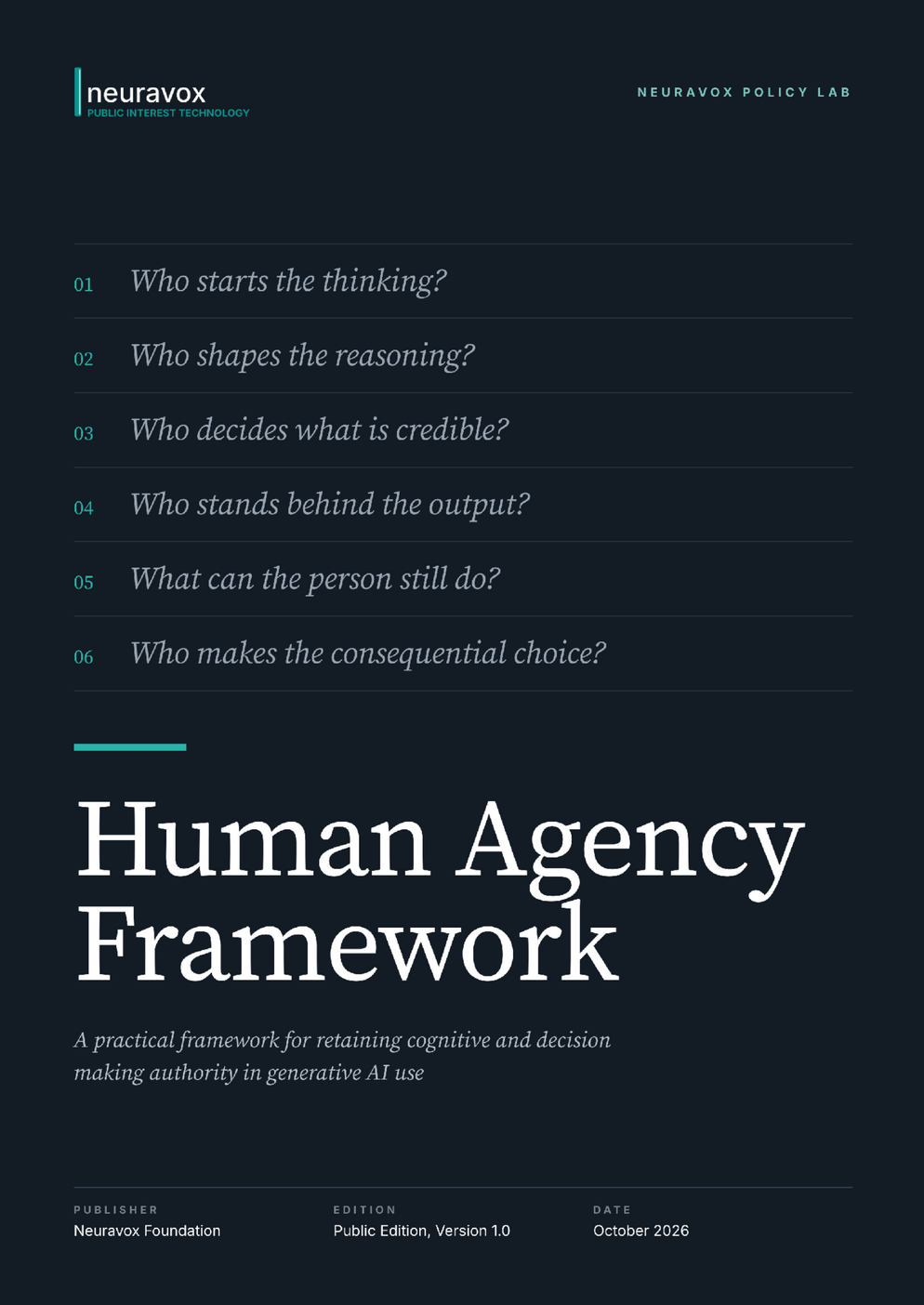
Who starts the thinking?
Form an initial view, question or attempt before AI defines the core problem.
A practical framework for retaining cognitive and decision making authority in generative AI use
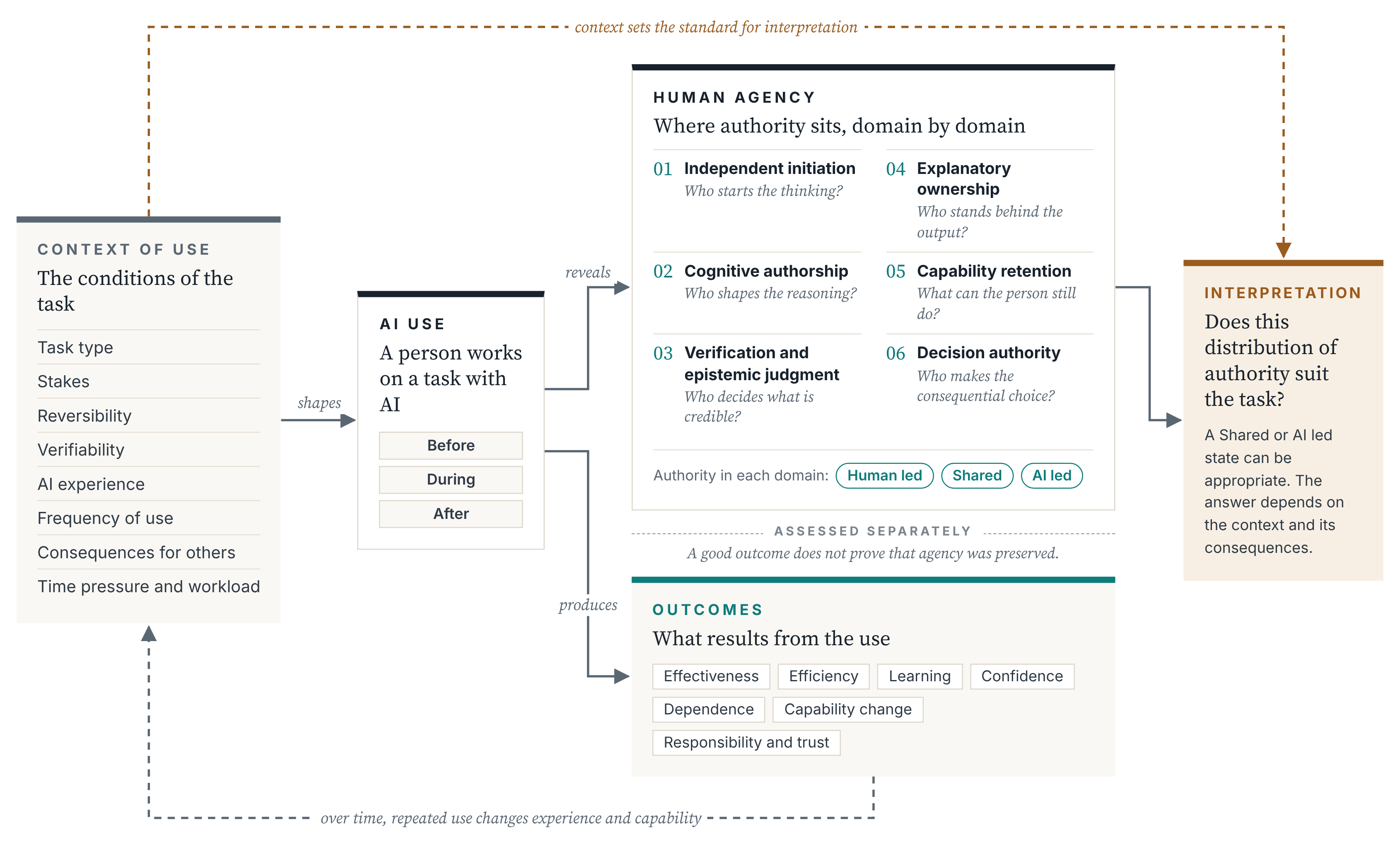
Generative AI now takes part in framing problems, synthesizing evidence, weighing options and recommending decisions. Counting prompts or hours of use cannot show who steers that work. The Human Agency Framework gives individuals, organizations, AI designers and policy teams a structured way to see where cognitive and decision making authority sits during AI use, and to judge if that distribution suits the task.
The framework builds on the Policy Lab report Human Agency in AI Use, published research on cognitive offloading, automation bias and critical thinking, and human centred AI principles from UNESCO, the OECD and the African Union. It reports a profile across six domains and gives no total score.
Each domain asks one observable question. Strength in one domain does not guarantee strength in another, so the framework reads them one at a time.
Who starts the thinking?
Form an initial view, question or attempt before AI defines the core problem.
Who shapes the reasoning?
Keep influence over structure, priorities, assumptions and direction.
Who decides what is credible?
Check important outputs, notice conflicts and reject unsupported answers.
Who understands and stands behind the output?
Explain the reasoning and the result in one’s own terms.
What can the person still do without AI?
Keep relevant knowledge and skill for when AI is unavailable or unsuitable.
Who makes the consequential choice?
Keep final authority over choices with personal, professional or social consequences.
Context shapes AI use. That use reveals where authority sits in each domain and produces outcomes, which are assessed separately. A good outcome does not prove that agency was preserved.
The person keeps primary direction. AI may assist.
AI contributes substantially. The person can still intervene.
AI largely determines the activity. Intervention is limited.
The three states describe where authority sits in one domain. A Shared or AI led state can suit a task. Interpretation depends on its stakes and consequences.
Reflect on how AI enters their thinking, learning, work and personal decisions.
Review AI enabled workflows, identify where human judgment is essential and design agency checkpoints.
Identify product choices that preserve user understanding, intervention and decision authority.
Translate human oversight principles into practical behaviours and accountability expectations.
Develop and test measures of human agency across tasks, populations and contexts.
A quick reflection tool, applied scenarios and an organizational review template come with the framework.
Abako, G. L. (2026). Human Agency Framework: A practical framework for retaining cognitive and decision making authority in generative AI use (Version 1.0). Neuravox Policy Lab, Neuravox Foundation. https://doi.org/10.5281/zenodo.23133846